Architecture
Disclaimer (by sven-n): This is not a perfect architecture, if such an architecture exists anyway. However, it makes sense to me for this purpose, as an enterprise business application developer. I tried to make it flexible and I hope it's not too complicated.
For the big picture, have a look at the architecture overview:
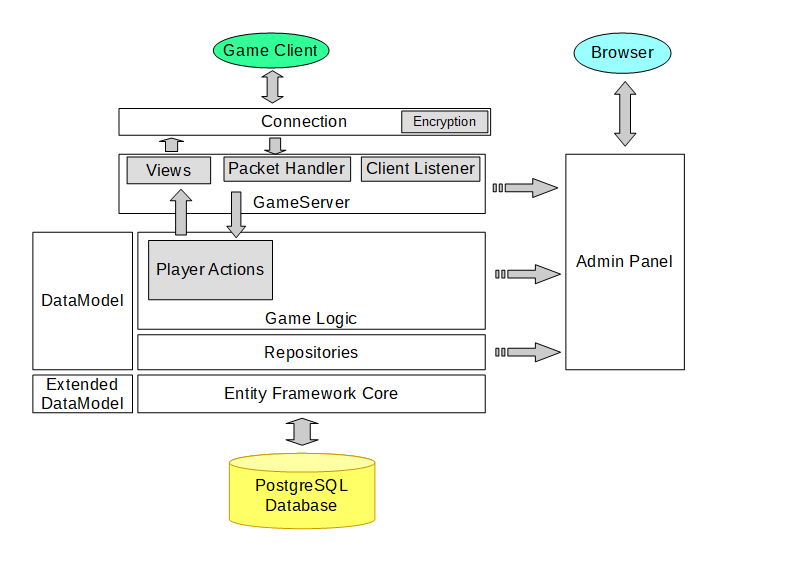
There are interfaces for the interoperability between the different "servers" or subsystems in MUnique.OpenMU.Interfaces.
Communication between game client and server
The network communication between game client and game server takes place through
the Connection class.
MUnique.OpenMU.Network contains everything required to connect from and to a
game server using the MU Online network protocol. It also contains the message
structs of the messages in MUnique.OpenMU.Network.Packets.
Client → Server
When data is received from the game client, it is forwarded to the packet
handlers in the namespace MUnique.OpenMU.GameServer.MessageHandler. Every
handler is an implementation of an IPacketHandlerPlugIn.
These message handlers parse the data packets and then call the player actions in
MUnique.OpenMU.GameLogic.PlayerActions, which have no knowledge of the packet
structure or how the communication took place.
Server → Client
The other way — data sent to the game client — is done by views
(MUnique.OpenMU.GameServer.RemoteView). These views use the Connection class
to send the data in the specified protocol. The game logic has no knowledge about
this protocol and just works with the
view interface plugins.
Benefits of this architecture
The game logic itself does not know how the player actions are triggered or how the "view" looks like.
Instead of working with the network, there could be an implementation of view plugins which is literally a graphical user interface. Also, instead of calling the player actions by packet handler plugins, a user interface could call them instead. So this project could be a base for a (non-MU) game client which could then also support multiplayer and co-op with the existing server components.
All plugins are configurable over the admin panel. They can be activated or deactivated, so they can be replaced by extended or modified versions.
It is also possible to offer different protocols working on the same game world, by implementing multiple view and packet handlers with different client version attributes. Each game server can have multiple TCP listeners bound to separate TCP ports for different client versions, too.
Game events for external systems
Notable events of the game, like the start of a mini game or a rare item drop,
can be published to the whole server as typed
GameEvent
records through IEventPublisher.GameEventAsync. They are produced by the
Game Event Publisher plugin, which translates the corresponding plugin points
of the game logic into events.
- In the all-in-one deployment, they are delivered to every
IGameEventListenerwhich is registered in the dependency injection. - In the distributed deployment, they are published to the Dapr pub/sub
component with the topic
GameEventAsync. The JSON contains the type of the event in the$typeproperty.
The events only contain simple values, so that they can be serialized. Names of
configuration objects are passed as the full value of a LocalizedString, so a
receiver can translate them.
Data access
The access pattern is mainly this:
- At server start, the game configuration is loaded.
- When a game client logs in, its account is loaded.
- During the game, the account data is saved at specific points and in a time interval.
Design goal
It should be possible to support multiple different databases, also NoSQL ones, without changing the game logic. For this purpose we don't just use SQL and database-specific code in the game logic.
The access patterns keep this in mind: instead of a lot of single calls to a lot of different repositories in the game logic, one big call should be done. For example, if we want to use a document based database, an account could be one document and the game configuration as a whole could also be one document.
Abstractions
To accomplish the design goals, the game logic (and other parts) use
abstractions, repositories,
to access data. These abstractions are located in the
MUnique.OpenMU.Persistence namespace.
We use a context-based approach to access data: the GameConfiguration is loaded through a GameConfigurationRepository while "using" a context, and each connected player uses its own player context to load its Account.
When saving an account, we actually save its context. The context then takes care that every required change is done at the database. When accessing or creating new persistent objects, the context needs to be "in use" on the current thread, because the actual context implementation may need to track these objects. It takes care of a lot of things, e.g. creating new objects. Contexts can be created with the PersistenceContextProvider.
Current implementation and supported database
At the moment the persistence layer is implemented by MUnique.OpenMU.Persistence.EntityFramework, which uses Entity Framework Core and PostgreSQL as database.
Future
Because the data model is pretty complicated (which is required if the configuration should be that flexible), a full relational model on a database is probably not the best thing to do, performance wise.
Currently, we use an approach to load the game configuration or account with just one big dynamically generated query which gives us the data as JSON. That's surprisingly fast — the query to load the really complex game configuration finishes in about 1.5 seconds.
If there is a problem in the future, we could go further and mix relational tables with JSON columns, or fully switch to a document based database.
Further reading
On this site:
- Solution structure — what lives in which project
- Packet documentation — the structures exchanged between client and server
The deeper, code-bound technical documentation stays next to the code in the repository:
- The plugin system — how to define a plugin point, implement a plugin, and load custom ones
- Master skill system
- GameMap — how the area of interest management works
- Packet structure tests
- Progress — the feature implementation progress
- Attribute system — damage calculation and player attributes are based on it